Rhaena Targaryen
Fire & BloodRhaena Targaryen is the name of two distinct women whose lives intersect the royal family’s struggles over inheritance, marriage, and the meaning of a dragon. The elder Rhaena, daughter of Aenys and Alyssa, bonds with Dreamfyre as a child and becomes a widow whose daughters’ safety and claim to the throne shape her choices. A later Rhaena, daughter of Daemon and Laena, grows up without a dragon, then becomes associated with the hatchling Morning; after the Dance, she and her twin are among the few Targaryens the people of King’s Landing regularly see. The contrast between the two lives is striking: one Rhaena’s dragon accompanies her through upheaval and grief, while the other’s delayed dragon becomes a public sign of a family’s possible renewal.
Identity and Background
The elder Rhaena was the eldest daughter of Prince Aenys and Lady Alyssa. As a child she was shy around strangers, hiding behind her mother or clinging to her father, and seemed more at ease with animals than with other children. She fed the castle cats, kept puppies in her bed, and preferred books to the companions her mother arranged for her. Her affection for her much younger sister Alysanne was unusually strong: Grand Maester Gawen remarked that Rhaena seemed almost like the baby’s mother. These details establish a private, inward childhood before her life became bound up with claims and conflict.
At nine, Rhaena received a hatchling from the dragon pits of Dragonstone and named her Dreamfyre. The two bonded at once. Three years later Rhaena flew for the first time, and although she remained quiet, her dragon changed how others saw her: she was no longer readily dismissed as timid. Her first close friend was her cousin Larissa Velaryon, whose departure from Driftmark to marry ended their inseparable companionship. Rhaena then found a new friend in Samantha Stokeworth, the Hand’s daughter. Even in childhood, friendship was shaped by the movements and marriage arrangements of noble households.
The later Rhaena was born in 116 AC in Pentos, one of twin daughters of Prince Daemon and Lady Laena. Daemon named the girls Baela and Rhaena after their grandparents. Both infants were small and sickly, but survived and sailed with their mother to Driftmark when they were stronger. This Rhaena, often called Rhaena of Pentos, was distinct from the elder princess of the same name. Her early association with dragons was one of absence rather than possession: her own hatchling had died, and when she was sent to the Vale she carried three eggs, praying for them to hatch.
Marriage, Bereavement, and Political Claims
The elder Rhaena married her brother Aegon, later known as Aegon the Uncrowned. When she gave birth to twin daughters, Aerea and Rhaella, at Casterly Rock, the High Septon denounced the children as the products of incest. The maester who attended the birth recorded that Rhaena urged her husband to take their family across the narrow sea, beyond the reach of his uncle. She was willing to give up her own life to make Aegon king, she said, but would not risk their daughters. Aegon refused to abandon his claim. The episode sets a lasting tension in their marriage: Rhaena’s immediate concern was the girls’ safety, while her husband remained fixed on his birthright.
Rhaena was not with Aegon when he marched to battle against Maegor. She remained at Pinkmaiden Castle with their daughters and Dreamfyre; the account leaves uncertain whether she stayed by her own choice or at Aegon’s command. The histories also question whether a second dragon might have changed the battle, while noting that Rhaena was no warrior and Dreamfyre was younger and smaller than Quicksilver, and no match for Balerion. After Aegon’s death, Rhaena acted to protect the twins. Aerea, as the elder daughter, might have asserted a claim to the Iron Throne, but the girls were barely a year old and such a claim could have endangered them. Rhaena dyed their hair, changed their names, and entrusted them to powerful allies to be fostered without knowledge of their true identities. She insisted that even she must not know where they had been sent, so that torture could not make her reveal their whereabouts.
When Jaehaerys began gathering forces at Storm’s End, Rhaena flew there on Dreamfyre, leaving Maegor, the uncle she had been forced to wed. She brought Aerea with her and took Blackfyre from the king’s scabbard as he slept. In the years that followed, she lived apart from her mother and sister on Fair Isle, while supporters in the west, riverlands, and parts of the Reach called her the Queen in the West. Her grief over Aegon’s fate became inseparable from political resentment. She believed Rogar Baratheon had failed to act when her husband faced Maegor, and could neither forget nor forgive that inaction. She also resented that her claim and her daughters’ claims had been passed over in favor of her younger brother Jaehaerys. She reminded those around her that she was the firstborn and had become a dragonrider before her siblings.
Dragonstone, Friendship, and Loss
Rhaena’s sense of exclusion did not end with her move to Fair Isle. When she left the island for Casterly Rock, she went on Dreamfyre and instructed her husband and companions to follow by ship. She discouraged her husband from challenging his brother to single combat, warning that his death would leave her widowed again and invite further suspicion against her. She expected Lyman Lannister, who had sheltered her before, to receive her. Later, when her brother asked what she wanted, she claimed Dragonstone: the place of her birth and, in her view, a possession to which her blood gave her a better claim than his. The demand made her grievance concrete in territory as well as succession.
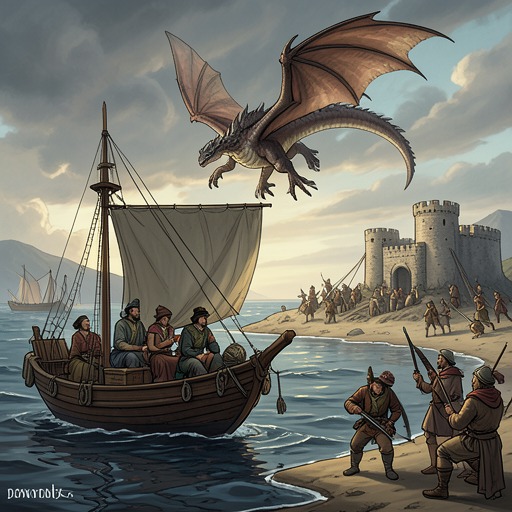
On Dragonstone, the bond between Rhaena and Elissa Farman became a source of both closeness and conflict. Elissa, denied a share of Fair Isle’s income by her brother, asked Rhaena for gold to build a large, swift ship at Driftmark and sail the Sunset Sea. Rhaena refused, saying she could not bear for Elissa to leave; Elissa heard only the refusal. When Elissa later announced that she would go, Rhaena said she would not beg her to stay. Aerea wept and clung to Elissa, asking to sail away with her and have adventures, but Elissa gently refused and said the girl’s place was at home. The departures reveal how Rhaena’s wish to keep those she loved near her could conflict with their desire to leave.
The loss of friends and companions plunged Rhaena into deep melancholy. The mention of her husband’s name provoked rage, and she repeatedly tried to send away her sister, even shouting at the queen in front of much of the castle. When her sister would not leave, Rhaena shut herself in her chambers and emerged only to eat, doing so less and less often. Later, returning from Estermont after a daughter’s death, she arrived too late to see the child alive. Only ashes and bones remained. Rhaena refused the king’s offer to bury them on Dragonstone, explaining that the girl had hated the island and wanted to fly. She carried the ashes high on Dreamfyre and scattered them on the wind. The act joins the dragon’s flight to an intimate expression of mourning, rather than to a political claim.
Morning and the Younger Rhaena’s Public Role
The younger Rhaena’s story follows a different course. Late in 129 AC, she was sent with Prince Joffrey to the Vale, where he was to help defend against the dragons of King Aegon. She was thirteen, Lady Jeyne Arryn’s ward, and not yet a dragonrider; the hatchling she had once possessed had died. She brought three dragon eggs and prayed each night that one would hatch. Her twin Baela remained on Dragonstone, determined to stay beside her betrothed, Jacaerys, and fight on her own dragon, though Moondancer was too small to carry her. The twins were separated by the war and by sharply different circumstances.
One of Rhaena’s eggs proved fertile, producing a pale pink hatchling with black horns and a crest. Rhaena named her Morning. The dragon was still too young to ride to war, but her birth mattered politically: Alicent warned that the rebels’ possession of a dragon, when the loyalists had none, might make the rebels seem more legitimate to the smallfolk. Rhaena’s egg therefore became more than a private hope. It gave the cause a living emblem, even before Morning could bear a rider into battle.
After Rhaena arrived in King’s Landing with Lady Jeyne, the smallfolk who had recently killed the city’s dragons greeted the sight of Morning with delight. Rhaena and Baela quickly became favorites of the city. Their half-brother, Prince Aegon, recoiled from Morning and demanded that the guards remove the creature from his sight, a response that underscored the divide between the prince’s fear and the public’s enthusiasm. Rhaena and Baela also pressed to see him, and Lady Jeyne supported their request. Their presence complicated Lord Cregan Stark’s plans and showed that the twins could exert influence through their public standing as well as their royal kinship.
By the time succession was discussed, the sixteen-year-old twins had become the most visible Targaryens in the capital. With King Aegon rarely appearing outside the Red Keep and the young queen remaining in her apartments, Rhaena and Baela rode out to hunt or hawk, gave alms, received envoys and visiting lords, and hosted the few feasts, masques, and balls. Council debate over which twin might make a better queen drew on their contrasting reputations: some favored Rhaena for her dragon, while others argued that Baela had been born first or that her wildness counted against her. Baela’s role in the death of the late king was also raised as a reason her coronation could reopen old wounds.
Rhaena’s years as Jeyne Arryn’s ward had brought her comfort and public admiration. Maids tended her, singers praised her beauty, and knights jousted for her favor; after her return to the capital, young lords competed for her attention and artists and dressmakers sought her patronage. Morning was often coiled around her shoulders. When the regents discussed her marriage, Rhaena accepted that she would wed as the king and council wished, while expressing a preference for a husband who was kind, gentle, and noble, and not so old or large that he could not give her children. She admitted a particular fondness for Corwyn Corbray, whom she had first known in the Vale. Though he was thirty-two, a second son, and already a father of two daughters, he was a renowned knight and carried Lady Forlorn, his house’s Valyrian steel sword. His brother Leowyn was Protector of the Realm. The match was swiftly agreed, followed by a wedding a fortnight later; the regents wanted Rhaena married quickly in case Baela was already with child.
Change and Narrative Significance
In 135 AC, at nineteen, the younger Rhaena flew Morning for the first time. On the third day of the third moon, she circled King’s Landing once before returning to the Dragonpit; each day afterward she flew farther. The sight of a dragon above the city had not been seen since the Dance, and Rhaena’s flight marked a change from years of waiting over an egg to a public role as a dragonrider. Later, when her husband had died, Baela went to Dragonstone to comfort her widowed twin and to ensure that Rhaena did not try to avenge his death herself on Morning. The dragon remained at once a source of status and a potential instrument of personal action.
The preparations for the king’s nameday and royal progress that followed show Rhaena’s continuing place in court life. Her wish to accompany the progress on her dragon was delicately deflected, while Baela declared that she would go whether invited or not. Rhaena’s path thus differs from that of her namesake: the elder princess’s story turns on a dragon already bound to her through dynastic upheaval, concealed heirs, and bereavement; the younger’s centers on an egg that eventually hatches into a sign of renewed Targaryen visibility. Across both lives, the name is associated with the limits imposed by succession and marriage, but also with attachments that exceed those arrangements: a child’s love for a sister, a mother’s protection of daughters, a friend’s departure, and the public hope invested in a dragon.